Manage artifact fields
Manage the fields that appear on all artifact types logged on your models. Choose from an array of field types with different properties and use cases.
Prerequisites
View, search, and filter artifacts fields
In the left sidebar, click Settings.
Under Artifacts, select Artifact Fields.
Displayed in groups2 as lists are the artifacts fields available to artifacts in your organization with a quick view of:3
Narrow down existing artifacts fields available to your artifacts by searching or filtering for results:
4 This count only applies to custom fields.
Click Search to search by keywords within an artifacts field.
Select whether to search in the Title or Description.
Click Search to narrow down your results by your entered keywords.
Expand any inventory field group to see more fields.
Click Filter to filter fields by any of the following criteria:
- artifact types — The types of artifacts that use this field.
- required on creation — Whether or not the field was set up as required on artifact creation.
- types — What type of field it is.
- workflow triggered by field — What workflows are initiated when this field is edited.6
- write permissions — Which model stakeholder types have permissions to edit this field.7
Click Apply Filters to narrow down your results by your configured criteria.
Expand any inventory field group to see more fields.
Add or edit artifact fields
In the left sidebar, click Settings.
Under Artifacts, select Artifact Fields.
Here you can edit existing artifact fields, or add a new one:
To add a new artifact field, click Add Field:
Artifact fields require you to enter a title (name), select a field type,8 and indicate what artifact types9 the field is available on.
Include optional information for your artifact field:
- Enter a custom field key.10
- Enter a description to indicate the purpose of the field displayed on the list of fields.
- Enter help text to provide guidance to users on how best to fill out that field.
- Check off whether or not the field should be required on artifact creation.
- Assign a field to a group.11
- Assign write permissions to allow granular access to editing this field gated by model stakeholder types or user roles. Leave this field blank for default permissions where only the Customer Admin role has write access.12
When you are satisfied with the setup of your artifact field, click Save.
10 If left blank, a key will be automatically generated in camelCase format.
11 Ungrouped fields will be listed under No Group: Add artifact field groups
To edit an existing artifact field:
Rename artifact field keys
To rename the field keys for artifact fields:
Hover over the actions column on the far-right for the field whose key you want to rename.
When the appears, click on it and select Rename Key.
Enter in the new key and click Check Availability.
If the key is not already in use, you’ll be presented with a list of dependencies to review.
Verify that these dependencies are correct and as expected.
Click Rename Key to apply your changes to the key.
Confirm that the dependencies updated are corrected and as expected.
Artifact field types
- Attachments
- Upload supporting files for your artifact.15 Files must be less than 50 MB each in size.
- Calculation
-
Define a
formula(params)function that automatically calculates and returns a value based on the params dictionary, which includes selected custom field keys retrieved from your other inventory model fields.
- Select from the drop-down of available artifact fields and model fields available via
params.modelto allow your formula access to the field’s values.16 - Replace the demonstration formula with your own in the code box provided.17
- Click Test Calculation to open the testing area.
- Enter in sample values in the testing area then click Test Calculation to validate your formula.
16 Fields are grouped by field type.
17 Stick to basic operations.
Keep your code simple and avoid complex logic and imports.
- Checkbox
-
A
true/falsevalue set by a toggle. - Date
-
- Date value in
yyyy-mm-ddformat. - Selection is in the current user’s timezone; other users viewing this field will see the value automatically in their timezone.
- Set the date format for date fields under your profile.18
- Date value in
- Date Time
-
- Date value in
yyyy-mm-dd, 24hrformat. - Selection is in the current user’s timezone; other users viewing this field will see the value automatically in their timezone.
- Set the date format for date time fields under your profile.19
- Date value in
-
Text value in valid email (
user@domain.com) format. - Long Text
- Toggle Enable rich text formatting to create a template using the rich text editor.
- Multiple Select
- Click Add Option to define a list of options.
- Number
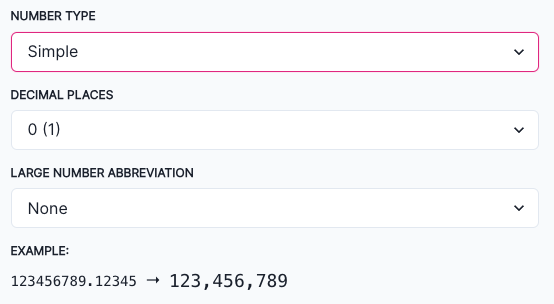
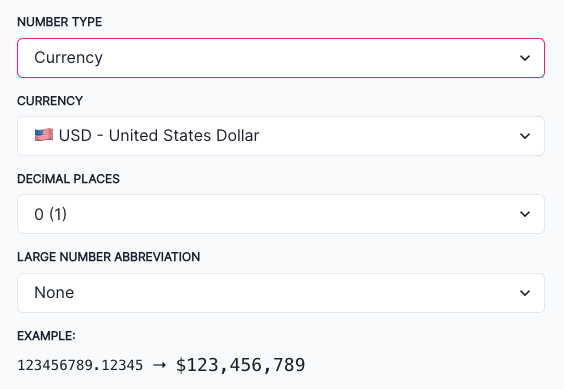
- Text value in valid number format. Number display (comma, fullstop, etc.) is determined by your browser’s locale. Select a number type:
- Simple — Define the decimal places that the number should be displayed up to and any large number abbreviations.
- Currency — Define the currency you would like the field to display in, as well as the decimal places that the number should be displayed up to and any large number abbreviations.
- Single Line Text
- Simple text value.
- Single Select
- Click Add Option to define a list of options.
- URL
- Text value in valid URL format.
- User
-
- Select list pre-populated with users from your User Directory.20
- Toggle allow linking to multiple records on to allow multi-selection of users.
20 Manage users
Add artifact field groups
To group artifact fields, first create an artifact field group:
In the left sidebar, click Settings.
Under Artifacts, select Artifact Fields.
Click Add Group and enter in a name and a description for the group.
Click Create Group to add the new group.
Assign the desired fields to the group.21
Delete artifact fields
In the left sidebar, click Settings.
Under Artifacts, select Artifact Fields.
Hover over the field you would like to delete.
When the appears under the Actions column, click on it and select Delete Field.
After you confirm, the field will be removed.